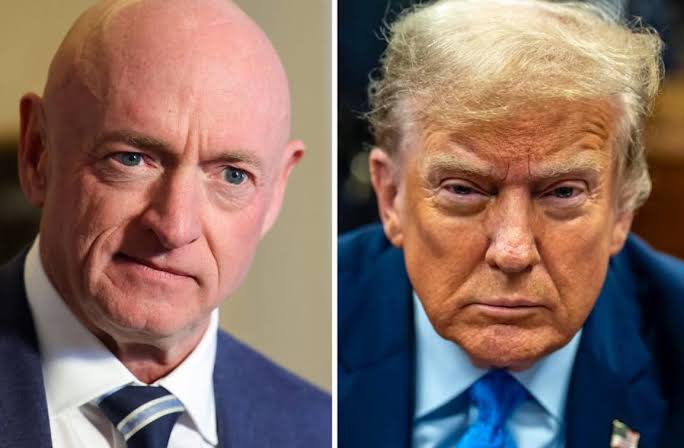
A political storm is gathering around President Donald Trump following a tense exchange with reporters at the White House, where the president found himself under intense scrutiny over his increasingly friendly relationship with Russian President Vladimir Putin.
The controversy erupted after CNN reporter Kaitlan Collins confronted Trump with a direct question about his description of Putin as a friend. The reporter reminded the president that Russia remains Iran’s biggest ally before asking whether he genuinely considered Putin a friend to the United States.
Rather than offering a straightforward answer, Trump delivered a response that immediately attracted attention.
“I can’t speak to America,” he replied.
The remark quickly became a major talking point, with critics questioning why the American president appeared unwilling to clearly establish whether the Russian leader was a friend or an adversary of the United States.
The reporter’s question touched on one of the most sensitive issues surrounding Trump’s foreign policy: his personal relationship with Putin at a time when Russia’s invasion of Ukraine continues to generate international condemnation.
TRUMP’S DEFENCE OF PUTIN RAISES MORE QUESTIONS
Instead of distancing himself from the Russian president, Trump went on to defend their personal relationship, describing it as very good.
He also revisited his longstanding grievances about the Russia investigation, which he repeatedly dismisses as a politically motivated hoax.
Trump suggested that Putin had treated him nicely during that difficult period, further explaining why he maintained a positive personal relationship with the Russian leader.
However, his explanation did little to silence critics who believe the president must distinguish between personal friendships and America’s national interests.
The controversy is particularly sensitive because Russia continues to wage war against Ukraine, while the United States remains an important international player in efforts to negotiate an end to the conflict.
UKRAINE WAR CONTROVERSY ADDS TO THE POLITICAL PRESSURE
Trump’s comments about the conflict have also attracted criticism.
During the same press conference, he suggested that both Russian President Vladimir Putin and Ukrainian President Volodymyr Zelenskyy were struggling to end the war, describing the two leaders as people who hate each other and remain stuck in the conflict.
His remarks have renewed concerns among Ukraine’s supporters, who argue that placing equal responsibility on both sides risks overlooking Russia’s decision to launch its full-scale invasion of Ukraine in February 2022.
For many critics, the bigger concern is whether Trump’s personal relationship with Putin could influence the direction of American foreign policy and future negotiations involving Ukraine.
The president’s approach has also drawn attention from America’s European allies, some of whom have openly expressed their opposition to treating Putin as a trusted friend.
Polish Prime Minister Donald Tusk, for example, firmly declared that Putin was not their friend and never would be.
IMPEACHMENT AND RESIGNATION DEMANDS ENTER THE DEBATE
As the controversy continues to generate political discussion, Trump’s critics are raising questions about his judgment, presidential responsibilities and commitment to protecting American interests.
Some opponents have invoked impeachment and resignation, arguing that the president’s comments deserve serious scrutiny.
However, the reported exchange itself does not establish grounds for impeachment, and no new impeachment proceeding has been confirmed in connection with these remarks.
Meanwhile, the controversy has placed renewed attention on the difficult balance between diplomatic relationships and national security.
Supporters of Trump may argue that maintaining personal communication with Putin is necessary to prevent further escalation and create opportunities for negotiations. Others insist that diplomacy should never come at the expense of American security or the sovereignty of Ukraine.
AMERICA WANTS ANSWERS
The central question now goes beyond Trump’s personal friendship with Putin.
Americans are left debating whether the president’s approach to Russia reflects a calculated diplomatic strategy or a troubling willingness to prioritize personal relationships over America’s broader interests.
With Russia’s war against Ukraine continuing and tensions involving Iran remaining a major international concern, Trump’s words carry consequences far beyond a single White House press conference.
For his critics, the president owes the American public a clearer explanation of where he stands.
And as the political debate intensifies, one question continues to dominate the controversy: If Putin is Trump’s friend, what does that friendship mean for the United States?